

.jpg)




.JPG)


Thursday I did a modification of this technique and wanted to reference my tutorial. That's when I went looking on my blog for my paste paper tutorial. I spent hours trying to find it, even though Blogger is fairly good with their search feature, providing you know keywords. When I couldn't find "paste papers," I typed in "Sta-flo" and other nonsense until I was convinced I had never posted it on my blog.
Since the post I had intended to show yesterday was a follow up to a paste paper tutorial, I decided I no longer had time to search for it, and went with Plan B (which if you were here yesterday was Halle's signatures). To make a long introduction even longer, I found the photos of the tutorial stored on a Yahoo site at low resolution. So you can bet they are not going to be the sharpest photos in the drawer, but at least I don't have to recreate the tutorial. Enough said. Let's make some paste papers.
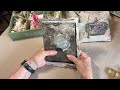
 From upper left clockwise:
Cups for mixing
Cheap acrylic craft paint
Sta Flo liquid starch (found at discount stores, drug stores, and supermarkets in the laundry section)
Various papers and substates
Credit cards cut using decorative scissors
Foam brush
Knitting needle
Bamboo skewer
Rotary cutter for pie crusts
Comb/pick
Pastry cutter
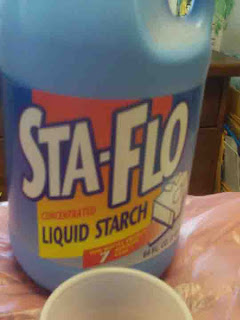 I am not sure if Sta-Flo is available in all countries, but it's concentrated liquid starch, so any concentrated liquid starch should work.
 Using your first cheap acrylic craft paint color, mix about 1 part paint to about 4 parts Sta Flo in a mixing cup. Stir well, then apply the first color with a brush. This is not an exact science, so if the mixture is too thin or too color saturated, add a bit more liquid starch. If too thick, or not enough color, add more craft paint. You don't need expensive acrylic paint for this technique, since the colors will become diluted anyway.
 Use a different mixing cup for each paint/Sta-flo concoction. I prefer to wait until the first color is dry before applying the second color, but you can brush the second color on at any time. Just be aware that when you apply the second color over the first wet color, you take the chance of losing the two distinct colors.
 Pick a tool, any tool, and, before the second color dries, begin running lines through it. The above lines were made with the pastry blender. Allow your pieces to dry. However, if you don't like your design, simply smooth the top color out with your foam brush and begin again. When pleased with your design, set aside to dry.
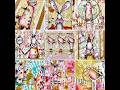
 I realize now that this was probably a very boring photo, because I didn't change my paint colors even though I used substrates with very different weights. On the left is some 110 lb card stock in which I used a hair pick to make the design. In the middle, and underneath everything is a large sheet of butcher paper that I used the pastry cutter on. In the back are (left) card stock and (right) photo mat decorated with a plastic hotel card I cut using decorative scissors. On the front right
 is a better view of a photo mat decorated using a rotary pie crust edger.
Tomorrow my dear cyber friend Caterina Giglio begins her four week on-line "Transfer Love" class, in which she will be teaching all kinds of wonderful transfer techniques. You can check it out here. I bet it's not too late to sign up, either.
Today I'm thinking about all those lovely pets many of us own. Julie Palmer is a pet portrait artist from the UK and my blog/artist pick of the day. If you are a pet owner, you might enjoy her web site filled with cat, dog, and horse portraits. Have a great Saturday and celebrate this last day of July, 2010.







 Dollar Exchange Rate