Showing posts with label book review. Show all posts

Tuesday, October 3, 2023

What's On Your Workdesk this 748th Wednesday?


It's Wednesday, which means it's time to join my dear friend and head desker Julia at Stamping Ground for the latest edition of What's On Your Workdesk, Wednesday, or as most know, WOYWW for short.   

 Before we begin, I want to apologize for this extremely LONG post.   I know Julia likes it short and sweet and normally I try to comply.  But that isn't the case today. 

Most of my long term readers know I was raised from birth by my grandparents.  Just wanted to get that out of the way in case it was news to you.

Today my desk is on my dining room table.  I've always said my entire house is my craft space, so here goes.

I'm going to get the obligatory rocking horse out of the way first.  Function is key for this

napkin holder.  Most of my cast iron is functional, like the door stop I shared last week.

One more look and it's back to the kitchen where it dispenses paper napkins.  Cloth napkins are used in the dining room.

Some of you remember I fell from trying to remove a box from a shelf in my guest bedroom.  I also mentioned I had received a very thoughtful gift which I had not yet photographed.  It was sent to me by Angela of Crafting with Jack.  I couldn't believe she was giving this book away and no one had asked for it.  I was happier than anyone can possibly imagine.

This is not a "normal" or "traditional" Sunbonnet Sue quilt.  

Instead, as you saw, this is an International Sunbonnet Sue quilt.  I hope you can read all the countries and symbols associated with International Sue.

This explains about International Sunbonnet Sue,

while this shows the first of the patterns you can make yourself.

Now, however, it was time to show why that book meant/means so much to me and why I'm going to cherish it.  I have my very own Sunbonnet Sue quilt, made for me by my grandmother.  She told me it was made from all the dresses she made me in kindergarten.

I was a tomboy.  I wanted nothing to do with girls in my neighborhood, because I was my grandfather's little helper.  My grandmother tried to correct that by making dresses for me.  I was probably the best dressed girl in kindergarten from the looks of all these fabrics.  But take a closer look.  Each and every stitch was by hand.

You may not be able to see it because the quilt needs to be ironed, but even the quilting is by hand.


I had to break this quilt into quarters to photograph it because it is big.

As you can see, I used it for years and years before I finally decided it was worth saving.  There are stains I was unable to remove and a few stitches have come undone due to my carelessness.

I can't possibly imagine wearing all those dresses to school, but there is the proof.

EDIT: I just counted and there are six across and nine down, which means there are 54 Sunbonnet Sues in my quilt. 

I'm not sure you can see the quilting, but it is at a diagonal.  I want to thank Angela one more time for the book which I will cherish more than she (or probably anybody) will know.  And I also appreciate my grandmother for her hand sewing skills.  I'm sure a few of you seamstresses and quilters will appreciate this post.

Thanks for stopping by my dining room table today.  Please join me at Julia's, where you will meet the kindest, most generous bloggers in the world.  I know that for a fact!!!


Saturday, July 22, 2023

A book review


I have several friends who review books each month.  Erika, Jeannie, and Mae are all voracious readers.  I, on the other hand, don't have an audible or a kindle, so I am one who reads books that require me to turn the pages one by one.   I am a slow reader and people have been amazed I have gotten so far in school.  I read it once and remember it.  I don't have to go back and read it a second time, unless it is so convoluted I don't understand it the first time.  That one advantage has been a lifesaver when it came to school.  I seldom studied for a test, because I knew what I had read.  Having said that, I know my friends I mentioned above read for pleasure and choose the books they want to read.  That is not the case with this book.

My no-name, no-photos-allowed group met three weeks ago on Wednesday.  The month before that we finally got our act together.  After a rather rocky start, we chose numbers from a basket and the person who got # 1 chose the first book.  For the life of me, I have no idea why she chose this book, but I was not looking forward to reading it.   Thankfully I didn't have to buy it.  The person who chose the book had two copies and she loaned them out to each of us to read and make notes.  We had a total of two months to read and prepare to discuss this book. 

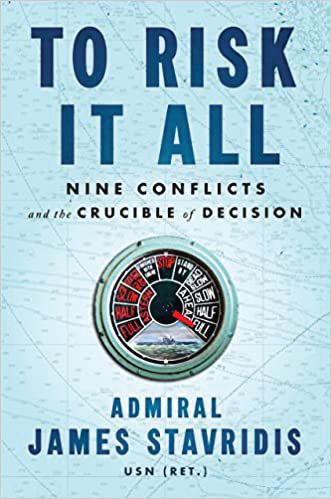
https://warfarehistorynetwork.com/wp-content/uploads/2022/10/To-Rish-it-All.jpg  This is the book we had to review.  It is Admiral James Stavridis’ "To Risk It All: Nine Conflicts and the Crucible of Decision."

This is a book about decision making gleaned from case studies in the U.S. Navy. There were nine cases ranging from 1779 to 2021.  I was actually familiar with one of these conflicts, so I will start there.  

If you are a news junkie, you will have heard the name Brett Crozier.  He was the captain of the ship (Theodore Roosevelt) that was in the Pacific in March, 2020 when Covid broke out on his ship.  Within days, dozens of men tested positive for the virus.  Although those with the virus were taken to a hospital in Guam, the remainder of the crew was/were ordered to stay on the ship, even though there was no way for social distancing on the ship.  Crozier wanted the remaining sailors who were not yet infected, removed and only a skeleton crew to stay on the ship.  His superior said that was impossible.  

Crozier decided to e-mail 10 naval officers, including his commanding officer, a four page message detailing the conditions on the ship and the impossibility of keeping Covid from spreading throughout the ship.  Somehow the message was leaked to the press and he was relieved of his command.  The crew was ordered on shore with only a skeleton crew allowed to stay to maintain the nuclear reactors and other essential ship equipment.  As he was being escorted off the ship, the sailors cheered and shouted Crozier's name.  Videos of Crozier's removal went viral on Twitter and the major news organizations picked it up.  

A Pentagon official said Crozier showed poor judgement, while others felt he did the right thing.  Some wanted him reinstated, unheard of in the Navy, while some, including then-president Trump thought Crozier did a terrible thing.  Crozier retired from the Navy in March, 2022. 

Although I started with the final conflict, Admiral Stavridis takes the conflicts in chronological order, beginning with John Paul Jones.  Jones, sometimes called the Father of the American Navy was a naval commander in the Revolutionary War.  Apparently he showed great courage at sea, where in 1779, he refused to surrender to the British warship Serapis. Unfortunately I found his story to be far less appealing than Stavridis apparently did.  

The next conflict was when in 1804 Stephen Decatur, captain of the USS Intrepid, set fire to the USS Pennsylvania after realizing it was too damaged to sail after it had been captured in Tripoli.  Making sure the entire ship was cleared then set on fire, Decatur and his crew proceeded under darkness.  According to Stavridis, Decatur's "audacity" and planning made sure the ship would be consumed of fire before he returned to the Intrepid (p. 58).  By that time, the Tripoli guards were unable to chase the Intrepid or save the Pennsylvania.  Decatur was declared a hero with his act of valor and garnered recognition of the newly founded US Navy. 

The next conflict showed how David Farragut, the first rear admiral, vice admiral, and full admiral in the US Navy fought in the Battle of Mobile Bay during the American Civil War (p. 66).  Mobile Bay was defended by several forts, the largest being Fort Morgan.  Mines on one side of the bay’s channel forced attacking ships to pass close to Fort Morgan on one side of the Mobile Bay channel.  Farragut attacked, but things didn't go as planned.  The first ship was blown up by the mines and the second ship stopped, froze, and didn't move through the channel.  Now all the ships were drifting in confusion in the channel.  As disaster seemed near, Farragut yelled his famous words, “Damn the torpedoes, full speed ahead!” to the dismay of the other ships.  He headed across the mines, which luckily failed to detonate.  Seeing Farragut's advances, the rest of the fleet followed.  What resulted was the now isolated forts surrendered one by one. 

The next conflict Stavridis discussed was that of George Dewey, the only man to make Admiral of the Navy (pp. 99-100).  After the Civil War, Dewey was convinced there would be a war with Spain and he studied the Spanish owned Philippine Islands. It was at this time he prepared his fleet for battle.  When war broke out, he headed to Manila Bay where the Spanish fleet was anchored near Cavite Island.  Dewey opened fire the following morning shortly before 6:00 a.m. and had sunk or destroyed most of the Spanish warships within about 90 minutes.  A few hours later, Dewey resumed action and met nearly no resistance, losing only one man during the action.  His victory resulted in the U.S. acquiring the Philippines.

Chapter 5 was perhaps my favorite of all the chapters.  I appreciated that it was the story of an enlisted man, 3rd Class Doris (Dorie) Miller.  Miller, an African American sailor, was one of the most unsung American heroes of World War II. His amazing actions during the Japanese attack on Pearl Harbor helped save many lives and served as an inspiration to countless others.  On December 7, 1941, Miller, while collecting laundry aboard the West Virginia, heard the alarm from General Quarters and rushed to his battle station, but found it had been destroyed.  Because of his strength and size, Miller was able to help several of his wounded ship mates to safety.  Among those he attended to was the ship’s commander.  Miller then manned a .50-calibre antiaircraft gun, for which he had no training, and continued firing on the enemy until he ran out of ammunition and received the order to abandon ship.  It is believed he shot down four to six Japanese planes.  For his bravery, he was awarded the Navy Cross, the Purple Heart, and the Combat Action Ribbon. 

Chapter 6 was my least favorite of all the chapters.  It covered William “Bull” Halsey and his battles in Japan during WWII.  Even Stavridis called him impulsive (p. 180). When fighting the Japanese, quick strikes and rapid withdrawal became Halsey’s trademark  Sailors under his command called his hurried retreats "Hauling ass with Halsey.”  Enlisted men loved him, Officers didn't want to work with him.  I found him rude, disrespectful, publicity hungry, and opinionated. Most notably Admiral Halsey's mistakes were nearly disastrous for the entire US invasion of the Philippines.

Chapter 7 covered Lieutenant Commander Lloyd M. Bucher who is apparently best known for being captured by the North Koreans.  Although officers and crew claimed the ship was in international waters all the time, North Koreans boarded the ship, killing one man and taking the ship and her remaining crew of 82 hostage.  Eleven months after being taken prisoner, Bucher and his crew were released.  Many of the men were nearly blind and most were malnourished.  Many claimed they had been tortured while in custody.  Bucher decided to not start an international incident.  During his court martial, for which he was determined not guilty, he said a ship could be replaced, but lives could not.  Years later, the U.S. government finally recognized the crew's sacrifice and granted prisoner-of-war medals to the crew. 

Rear Admiral Michelle Howard was the subject of Chapter 8.  She held many firsts.  She was a four-star admiral who served as the commander of United States Naval Forces Europe, while simultaneously serving as commander of Allied Joint Force Command Naples and United States Naval Forces Africa.  She was the first African-American woman to command a United States Navy ship, the first to achieve two- and three-star rank, the first admiral selected from the United States Naval Academy class of 1982, and the first female graduate of the United States Naval Academy selected for flag rank. Howard was the highest-ranking woman and first female four-star admiral in United States Naval history.  The real reason Stavridis chose her was because she led a multinational task force which conducted counter piracy operations in the Indian Ocean. She played a key role in the rescue of Captain Richard Phillips, whose kidnapping by Somali pirates made news around the world and later became a major motion picture.  Phillips I knew about, Howard I did not.

To Risk It All was published on May 24, 2022.   There are 352 pages.  Did I enjoy it?  Yes and no.  It is certainly not something I would have chosen and had I not been "forced" to read it, I would not have.  One thing I appreciated was Stavridis is an excellent writer.  There were certain chapters I appreciated.  Others I skipped over.  I took very careful notes of the chapters I enjoyed and wrote comments covering the ones I was not fond of.  I'm not sure what to expect when we discuss this book next Wednesday when we meet, but I sure hope our second book is more to my liking.  I know when it's my turn, I will choose a mystery.  No historical naval stories for me.  

Thank you for reading along with me.  I'm sure many of you didn't read it, but I shared this so I could print it out and take it, along with my other notes, to our meeting.  I guess this was for my benefit, but I wanted to prove to Mae, Jeanie, and Erika I DO read books on occasion and not just peer journals and journal articles.


Tuesday, May 2, 2023

Second on the 2nd: T Stands For Writing Home


If this post looks familiar, you are seeing double on purpose.  This is a T Tuesday post, as well as a Second on the 2nd.  If your T Tuesday post is the same as your Second on the 2nd, please share them both places.  If you are only here for T Tuesday, please disregard this post.

This post was first published on September 30, 2013


I had just reviewed the book Writing Home: Collected Essays and Newspaper Columns which is a compilation of stories written over several years about such things as family time, "momisms," working from home, and other relatable incidences.  Funny at times, heartwarming at times, and tear-jerking at times, you will probably have trouble putting this book down.

Although I don't usually include what's written on the book cover, here is what the publishers had to say about LeFerle's book.

Both a "motherhood memoir" and a handbook for living, Writing Home is a heartwarming anthology of domestic essays and lifestyle columns by award-winning journalist Cindy La Ferle. This timeless collection speaks to every suburban parent who has ever attempted to combine work, parenthood, and homekeeping. La Ferle's essays address such key issues as losing a parent, aging gracefully, reinventing family traditions, facing the empty nest, and finding deeper meaning in the small but defining moments of everyday life. Writing Home has won four awards for creative nonfiction, including one from Midwest Independent Publisher's Association and another from Writer's Digest. Think Club Publications voted Writing Home Book of the Year in 2005, praising it for its values-driven content. Midwest Book Review describes Cindy La Ferle's essays as "Little gems of wisdom from a modern working woman who has a valuable and interesting philosophy on life." The book has been featured on Sirius Radio and in other national media.

Personally, I couldn't have said it any better!  And this gives you a very good preview about what is contained in these 294 pages that features more than 90 essays.

  This is what my copy of this book looks like.

  And yes, it is signed by the author herself.

There are 12 chapters, with several essays in each.  Even the essay titles are funny, like (under House and Garden) "Trowel and Error" and "Zen and Remodeling."

Although I have never been a mother, and quickly explain that Bleubeard's mother is a calico who lives (or now probably lived) in a house in MO, under Child Care are gems like "Quit Picking on Barbie" and "Swamp Hair."  So you don't have to be married or a parent to appreciate LeFerle's humor.

Possibly my favorite was in the chapter called Keeping Up Appearances where I found an essay entitled "Recovering Perfectionist."  I might have to take that one to heart! 

Speaking of Bleubeard, I was brought to tears in the Creature Comforts chapter where I found such essays as "Eulogy for a Very Fine Cat" and "Booger."  Grieving can be so personal, but LeFerle makes it seem less so.

  I've now moved to my dining room table where I continue to review this book.

Since this is T day, I was intrigued by an essay in the chapter called Kitchen Duty entitled "Just My Cuppa Tea."  I thought the essay was quite appropriate and it had me agreeing as I read each word.


  LeFerle provides a bit of history lesson by explaining (as most avid tea drinkers know) 


  tea originated in the Orient (please ignore the kitty toys under the table),


  was first imported to the British Isles,

  then to the US, where it was heavily taxed. LeFerle then reminds us why tea has lost favor in this coffee obsessed world.  According to LeFerle:

As most of us recall from our grade-school history classes, it was heavily taxed by the Monarchy and eventually incited the boisterous Boston Tea Party of 1775.  Since then, our country (please note: LeFerle is referring to the United States) has harbored a stubborn preference for coffee (page 108).

She further contends that coffee is quick and all-American, easily being consumed in disposable cups, many of them, in my belief, more than likely styrofoam.

LeFerle admits tea is not easy to prepare.  It requires "that we sit down long enough to assemble its various accouterments (page 108)."  Take these strainers for example.  They go by several names, such as tea balls, strainers, and infusers.  One is needed any time we use tea leaves. 

  To further quote LeFerle:

Drinking tea entails a fussy battery of saucers, spoons, bags, lemon wedges, and pots with lid, not to mention the optional milk, honey, or sugar (pp 108-9).

All that fussing for something that begins with a bit of hot water may be why most waiters don't care for tea drinkers.  Per LeFerle, waiters think:

we're a high maintenance bunch and would rather not be bothered with our hot water refills (p 109).     

Now it's time to share your Second on the 2nd. The rules are quite simple and everyone is welcome to join the fun look back.  All you have to do is bring back a post that you are especially proud of, or perhaps one you shared before anyone knew your blog existed.  Any post, any genre, any artistic endeavor is acceptable, as long as it's been published sometime in the past.  Then link below (direct links only, please) and Bleubeard and I, along with other Second on the 2nd friends, will be by to visit.  Remember, this link is ONLY for Second on the 2nd.  If your T Tuesday post is the same, please share both places.

You are invited to the Inlinkz link party!

Click here to enter


Monday, May 1, 2023

T Stands For Second on the 2nd


This is a T Tuesday post, as well as a Second on the 2nd.  If your T Tuesday post is the same as your Second on the 2nd, please share them both places.  If you are only here for T Tuesday, please disregard the next post when it goes live.  I realize last week I said I would open my gifts and share what I received today, but, at the time, I had not realized this was a Second Look T Tuesday.

This post was first published on September 30, 2013


Writing Home: Collected Essays and Newspaper Columns is a compilation of stories written over several years about such things as family time, "momisms," working from home, and other relatable incidences.  Funny at times, heartwarming at times, and tear-jerking at times, you will probably have trouble putting this book down. 

There are 12 chapters, with several essays in each.  Even the essay titles are funny, like (under House and Garden) "Trowel and Error" and "Zen and Remodeling."

Although I have never been a mother, and quickly explain that Bleubeard's mother is a calico who lives (or now probably lived) in a house in MO, under Child Care are gems like "Quit Picking on Barbie" and "Swamp Hair."  So you don't have to be married or a parent to appreciate LeFerle's humor.

Possibly my favorite was in the chapter called Keeping Up Appearances where I found an essay entitled "Recovering Perfectionist."  I might have to take that one to heart! 

Speaking of Bleubeard, I was brought to tears in the Creature Comforts chapter where I found such essays as "Eulogy for a Very Fine Cat" and "Booger."  Grieving can be so personal, but LeFerle makes it seem less so.

I had just reviewed the book Writing Home: Collected Essays and Newspaper Columns which is a compilation of stories written over several years about such things as family time, "momisms," working from home, and other relatable incidences.  Funny at times, heartwarming at times, and tear-jerking at times, you will probably have trouble putting this book down.

Although I don't usually include what's written on the book cover, here is what the publishers had to say about LeFerle's book.

Both a "motherhood memoir" and a handbook for living, Writing Home is a heartwarming anthology of domestic essays and lifestyle columns by award-winning journalist Cindy La Ferle. This timeless collection speaks to every suburban parent who has ever attempted to combine work, parenthood, and homekeeping. La Ferle's essays address such key issues as losing a parent, aging gracefully, reinventing family traditions, facing the empty nest, and finding deeper meaning in the small but defining moments of everyday life. Writing Home has won four awards for creative nonfiction, including one from Midwest Independent Publisher's Association and another from Writer's Digest. Think Club Publications voted Writing Home Book of the Year in 2005, praising it for its values-driven content. Midwest Book Review describes Cindy La Ferle's essays as "Little gems of wisdom from a modern working woman who has a valuable and interesting philosophy on life." The book has been featured on Sirius Radio and in other national media.

Personally, I couldn't have said it any better!  And this gives you a very good preview about what is contained in these 294 pages that features more than 90 essays.

   This is what my copy of this book looks like.

  And yes, it is signed by the author herself.


  Today's T post begins with this book some of you may have seen me review last Friday for our monthly Artful Readers Club.

In case you didn't see the review, the book is called Writing Home and was written by Cindy Leferle.  It has many (over 90) short essays on home, women working, and various other stories most of us can relate to.

Since this is T day, I was intrigued by an essay in the chapter called Kitchen Duty entitled "Just My Cuppa Tea."  I thought the essay was quite appropriate and it had me agreeing as I read each word.

LeFerle provides a bit of history lesson by explaining (as most avid tea drinkers know)

tea originated in the Orient (please ignore the kitty toys under the table),

was first imported to the British Isles (thank you Annette aka Voodoo Vixen for gifting me with everything tea related shown in this photo),

then to the US, where it was heavily taxed. LeFerle then reminds us why tea has lost favor in this coffee obsessed world.  According to LeFerle
As most of us recall from our grade-school history classes, it was heavily taxed by the Monarchy and eventually incited the boisterous Boston Tea Party of 1775.  Since then, our country (please note: LeFerle is referring to the United States) has harbored a stubborn preference for coffee (page 108).
She further contends that coffee is quick and all-American, easily being consumed in disposable cups, many of them, in my belief, more than likely styrofoam.

LeFerle admits tea is not easy to prepare.  It requires "that we sit down long enough to assemble its various accouterments (page 108)."  Take these strainers for example.  They go by several names, such as tea balls, strainers, and infusers.  One is needed any time we use tea leaves.

To further quote LeFerle
Drinking tea entails a fussy battery of saucers, spoons, bags, lemon wedges, and pots with lid, not to mention the optional milk, honey, or sugar (pp 108-9).
All that fussing for something that begins with a bit of hot water may be why most waiters don't care for tea drinkers.  Per LeFerle, waiters think
we're a high maintenance bunch and would rather not be bothered with our hot water refills (p 109).      

Show your high (or low) maintenance today and link below.  Your photos don't have to be taken on Tuesday, but they should be somehow T related.  Art, books, stories, or even a good pot of tea will be memorable when you link below and are visited by your fellow T community.


Thursday, March 2, 2023

Second on the 2nd


For my second look, I like to share art that somehow relates to the artist and host of the month at Art Journal Journey.  Since Valerie chose Anything Goes, I looked back to August 29, 2013, where I reviewed an art book.  It was part of Darcy's monthly Artful Readers Club (ARC).  We reviewed one book each month, then created art that inspired us from that book.  I created:

Vintage Collage Works by Maryjo and Sunny Kock

Quarry Books, 2008. Softcover.

ISBN 13: 9781592533909
Publisher: Quarry Books
Publication Date: 2008
Binding: Softcover

Please be aware, these photos were taken with my very old camera that often took illegible photos.  Poor technology coupled with amateur photographer who was used to a SLR.  I tried to copy the post word for word.

  It's definitely a softcover book, but it is packed with lots of vintage collages and assemblages. 

There are only three chapters, but don't let that fool you. 

And even though the beginning of this book is like many other art books that don't specify the name of the tools, and  

although I had not heard of a few of the tools, I realized I had enough of the essentials, I would have no problem keeping up with the authors of this book.  A few things I had not heard of (under paints, mediums, varnishes) were Oxgall, and (under brushes) Scumbling or Filbert brush and Linear brush. 

The first chapter covered vintage papers, which included 

old letters and envelopes,

as well as postcards, and how to alter them. 

Then there was scrap art, something I had never heard of before.  I read what it was, saw examples, and still had no idea what the authors were talking about.  As an aside, we now call it collage fodder!

Of course, wallpaper is something I really enjoy working with, as I do

vintage sheet music.

I have a ton of flash cards, although they are math and music related.  I would never have thought to alter them, though, so that was a fun surprise.  As an aside, I now alter flash cards a lot. 

 And I have a few old maps, but they may not be vintage.  However, I knew this was the chapter in which I would find my inspiration.

  I love old boxes, but I can't afford to buy cigar boxes. They are simply out of my price range.  Someone has learned they are used in art projects, so now all the cigar and liquor stores (where they are mostly found in my town) charge anywhere from $5.00 (USD) for cardboard to $15.00-$25.00 (USD) for wooden.  So as much as I would love to alter a box and turn it into a vintage masterpiece, I won't be doing that anytime soon.  At least not until I find less expensive boxes.

  The final chapter deals with nature, which includes

  more boxes, but this time with variations such as bird themes. 

  The authors even showed an example in an altered book, and a note card.

  All that was left was page after page of lovely clip art the artists included.

 I'm sure the observant reader has noticed many of these pieces were used by the authors in their own artwork. 

  Although I really love what the authors shared, I have so much stuff I need to use, I prefer to alter my own ephemera and leave my printer ink for more important uses.  As an aside, this is back when I had colored ink in my printer. 

Another thing I liked about this book was there were two writers/authors, mother and daughter Maryjo and Sunny Kock  All the artwork came from them, something you don't always see in books of this caliber or quality.  Oftentimes, authors ask others to share contribute their art, too, but that was not the case with this book. Reading through the credits (page 142), there are about equal entries from both artists.

Unlike last month, where I could not find anything inspiring to make, this month's ARC entry was sensory overload. 

I began by gathering a few bits of ephemera I thought might work well together.

Last month I attempted a tape transfer that was unsuccessful.  I was hoping that would not be the case this month, so I started with the transfers using clear adhesive book covering. 

I created a substrate of two pieces of cardboard (8 inches X 10 inches, or 20.32 centimeters X 25.4 centimeters) that I covered with vintage sheet music.  Here I've auditioned a couple of flowers I pressed.  Unfortunately, as much as I'd love to use them, I fear they are the wrong colors.  I also auditioned the clear buttons, but decided even if I colored them, they were not the vintage style I was looking for.

Although I fussy cut both birds from wallpaper samples, I was unhappy that they both faced the same direction.  I had some real decisions to make before I could call this a completed work of art.

Then I remembered the artists showed how to alter vintage postcards.  And although I was not inspired to alter them, I was inspired to use them.

  And with that, the piece came together nicely.  Although a name for this piece eludes me, I think it contains a story only the reader can conjure up.

  All that's left are a few detail shots.  Tape transfer on flash card, wallpaper bird on matching wallpaper fabric.

Postcard and fussy cut bird.

Another post card and tape transfer.

For the first time, I have to gladly give this book a rating of 5 out of 5 stars.  I was really impressed with the inspiration I got from it. 

________________________________


You have seen my second look, now it's time to share your own Second on the 2nd.  The rules are quite simple and everyone is welcome to join the fun look back.  All you have to do is bring back a post that you are especially proud of, or perhaps one you shared before anyone knew your blog existed.  Any post, any genre, any artistic endeavor is acceptable, as long as it's been published sometime in the past.  Then link below (direct links only, please) and Bleubeard and I, along with other Second on the 2nd friends, will be by to visit.